
06 May 2026
The City of Dresden is continuing to explore innovative and sustainable urban technologies within MOBILITIES FOR EU. As part of the city’s smart mobility and automation activities, two autonomous service robots have now been introduced at the Sportpark Ostra. An autonomous cleaning robot is already in operation at the Heinz-Steyer-Stadion, a major athletics and sports stadium in Dresden’s Ostragehege, while an intelligent artificial turf maintenance robot is currently being prepared for deployment on the artificial turf pitches.
The autonomous cleaning robot, the TASKI GS Ecobot 50 Pro, has officially been in permanent operation at the stadium since November 2025. Using AI-supported navigation and pre-programmed digital maps, the robot independently cleans indoor floor areas by automatically following predefined routes. Equipped with advanced sensors, cameras and LiDAR technology, the robot can safely navigate even complex environments while optimising cleaning efficiency and reducing resource consumption.
The system is capable of autonomous route planning, obstacle detection and real-time adaptation during operation. With a cleaning capacity of up to 1,800 m² per hour and intelligent water recycling technology that can reduce fresh water consumption by up to 80%, the robot contributes not only to operational efficiency but also to Dresden’s sustainability ambitions.
Complementing this innovation, Dresden has also received an artificial turf maintenance robot, the Turfrob. The installation and electrical connection are currently being planned, with commissioning expected in the coming months.
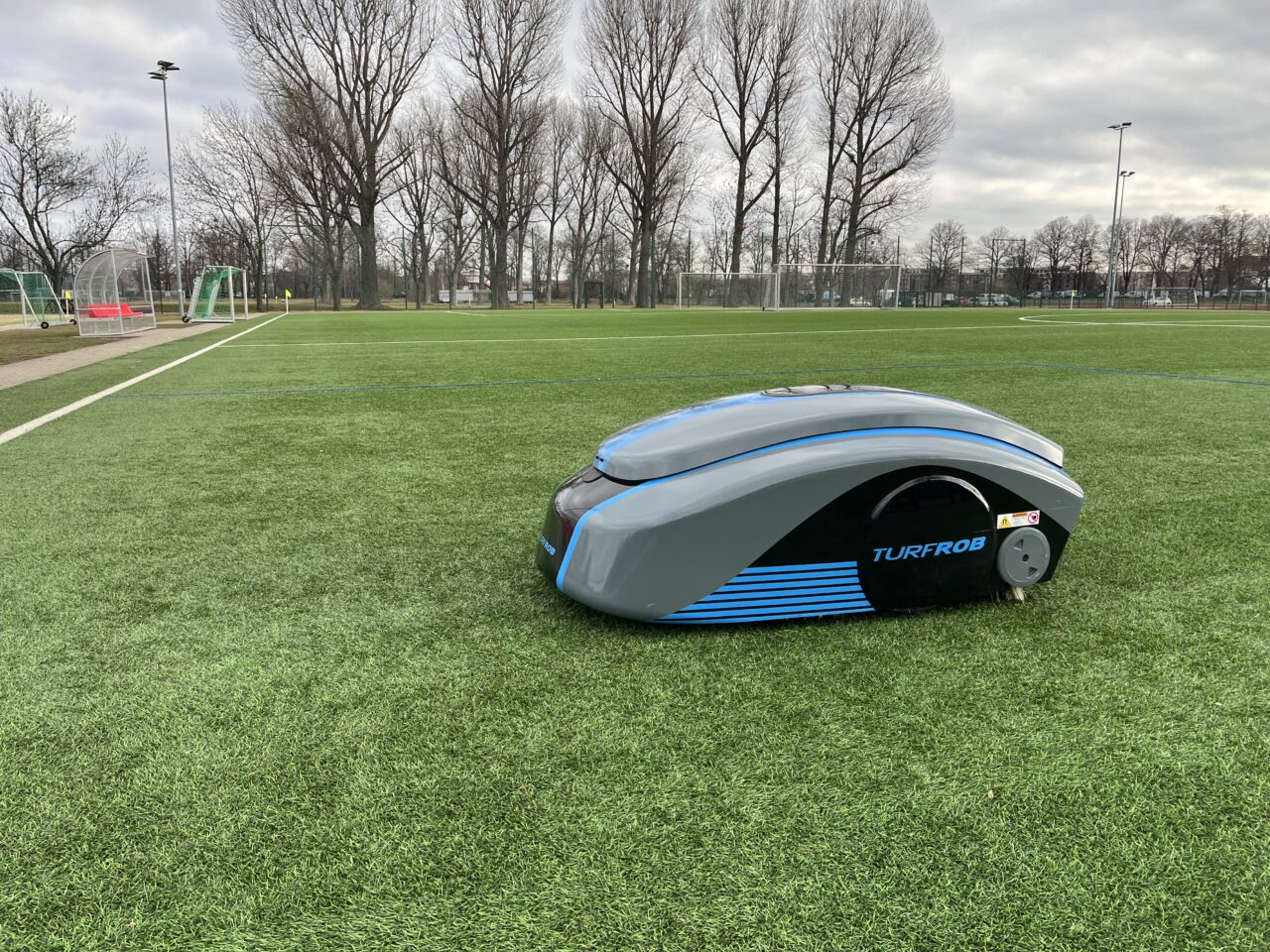
The Turfrob robot is designed specifically for the autonomous maintenance of artificial sports turf. Controlled via smartphone app and GPS-supported navigation, the robot independently carries out tasks such as brushing, loosening and redistributing infill material to ensure consistent playing conditions and extend the lifespan of the pitch.
By automating regular turf maintenance, the system allows sports facilities to maximise playing time while maintaining high-quality pitch conditions throughout the year. According to the manufacturer, the robot can operate fully autonomously, including at night, helping operators reduce manual workload and optimise maintenance processes.
The deployment of both robots demonstrates how Dresden is testing practical applications of automation and robotics beyond transport itself. Within MOBILITIES FOR EU, the city is using real-world urban environments to explore how smart technologies can improve sustainability, operational efficiency and quality of life in cities.
These new additions further strengthen Dresden’s role as a leading European testbed for innovative urban solutions and smart city technologies.
© 2026 Mobilities for EU
Social Media


Project Coordinator
Julia Vicente Gómez, CARTIF
julvic@cartif.es
Main Press Contact
Rebecca Sinai, Steinbeis Europa Zentrum
rebecca.sinai@steinbeis-europa.de


This website exists in the context of the MOBILITIES FOR EU project which is co-financed under the Horizon Europe research and innovation programme under grant agreement No 101139666.