16 March 2026
MOBILITIES FOR EU partner AEDIVE has organised several events in the first quarter of 2026 with the aim of promoting sustainable mobility, the electrification of transport and talent within the sector, with two events standing out in particular: the launch of the 2025–2026 Electric Mobility Yearbook and the eMobility Madrid Hackathon.
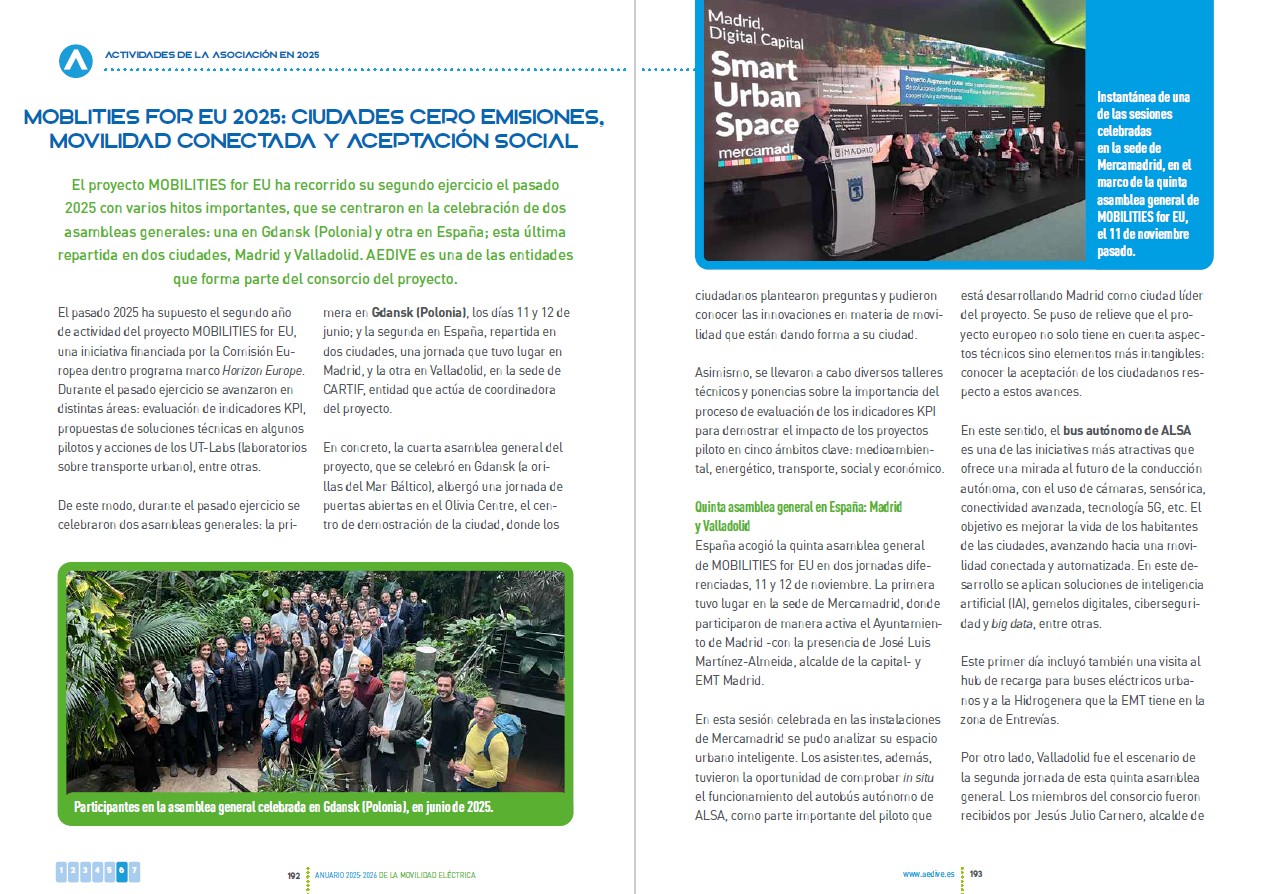
Firstly, the association officially presented its 2025-2026 Electric Mobility Yearbook on 20 February in Madrid, attended by over 200 people. This document summarises the key data and current state of the electromobility sector, looking ahead to prospects, alongside articles on trends, regulation, the market and technology, amongst other topics.
In this regard, two contents of the Yearbook are particularly noteworthy due to their connection with the MOBILITIES FOR EU project. The first, entitled “MOBILITIES FOR EU 2025: zero-emission cities, connected mobility and social acceptance”, focuses on two key events in 2025: the two general assemblies, one held in Gdańsk (Poland) and the other in Spain; the latter taking place across two cities, Madrid and Valladolid.
On the other hand, Laura del Río, an assistant professor at the Polytechnic University of Madrid (UPM), a member institution of the consortium, is the author of the article “Beyond eMaaS: towards an integrated economic model for urban electric mobility”, which discusses the rapid structural change currently taking place in urban electric mobility due to the application of artificial intelligence (AI), consolidating the eMaaS (eMobility as a Service) model.
The second major event took place on 6 and 7 March: the first edition of the eMobility Madrid Hackathon, an event promoted by AEDIVE, which brought together university students, industry professionals and leading companies to collaborate on innovative electric mobility solutions for urban environments. Arturo Pérez de Lucia, the association’s director general, explained the main lines and objectives of the MOBILITIES FOR EU project to those present.
The event, which included mentoring sessions for young students, was organised in collaboration with Camilo José Cela University in Madrid and featured the participation of a senior official from the Madrid regional government.
The aim of the Hackathon is to bring the sector’s real-world challenges closer to young talent and to foster new ideas that contribute to the advancement of sustainable mobility. Over the two days, the students, divided into groups, presented innovative proposals related to urban electric mobility, addressing challenges such as the optimisation of charging infrastructure, data management and the integration of new mobility services in cities.
© 2026 Mobilities for EU
Social Media


Project Coordinator
Julia Vicente Gómez, CARTIF
julvic@cartif.es
Main Press Contact
Rebecca Sinai, Steinbeis Europa Zentrum
rebecca.sinai@steinbeis-europa.de


This website exists in the context of the MOBILITIES FOR EU project which is co-financed under the Horizon Europe research and innovation programme under grant agreement No 101139666.